

Nanotechnology, long considered a futuristic concept, is now firmly rooted in reality, transforming various industrial sectors with its innovative applications.
In this blog, we will explore how nanotechnology is redefining standards of innovation and sustainability.
Learn about the positive impact TNS additives can have on your operations and discover how nanotechnology can be the key to your competitive advantage.
What is nanotechnology?
Nanoparticulate materials—that is, materials composed of particles on the nanoscale—have properties that differ from those of their larger-scale counterparts.
This is because the particles are nearly the same size as the atoms that make up the material (one billionth of a meter), which alters their electronic properties.

A simple example is what we do with coffee beans: we grind them into powder, thereby enhancing their flavor potential.
Where is nanotechnology used?
Currently, there are countless applications of nanotechnology, including the following:
- Antimicrobial agents;
- Biosensors;
- Cosmetics and sunscreens;
- Water-repellent materials, such as textiles, footwear, etc.;
- And many more!
Read more at: Antibacterial and bacteriostatic? What’s the difference?
How does TNS Nano technology protect surfaces?
Many people wonder whether they should believe the countless advertisements and commercials out there about various antimicrobial surfaces, especially if they’ve heard and seen a lot of them during the pandemic.
These areas range from:
- Textiles;
- Polymers;
- Flooring;
- Ceramic tiles;
- Paints, etc.
We have numerous studies and tests that prove and confirm that nanotechnology works.
Read more at: How antimicrobials benefit the footwear industry
The Importance of Nanotechnology in Industry
You might not see them, but they're right there! That's right!
TNS Nano’s technologies protect environments and products to promote comfort and well-being, but behind every major innovation lie extensive research and highly specialized scientists in the field.
And it is thanks to this technology that it is possible to incorporate antimicrobial agents into various substrates and materials.
What are the benefits of using nanotechnology?
There are numerous benefits to applying nanotechnology in various sectors, for example:
- It does not change the production process;
- Increases the contact area;
- Incorporates state-of-the-art technology;
- Because the quantity is so small, there are significant cost savings;
- It provides greater protection when used as an antimicrobial.
Antimicrobial nanotechnology that really works!
TNS Nano's antimicrobial technology offers high efficacy, particularly against a wide range of microorganisms.
This is what happens, as shown in the image below, where one surface contains our additives and the other does not.
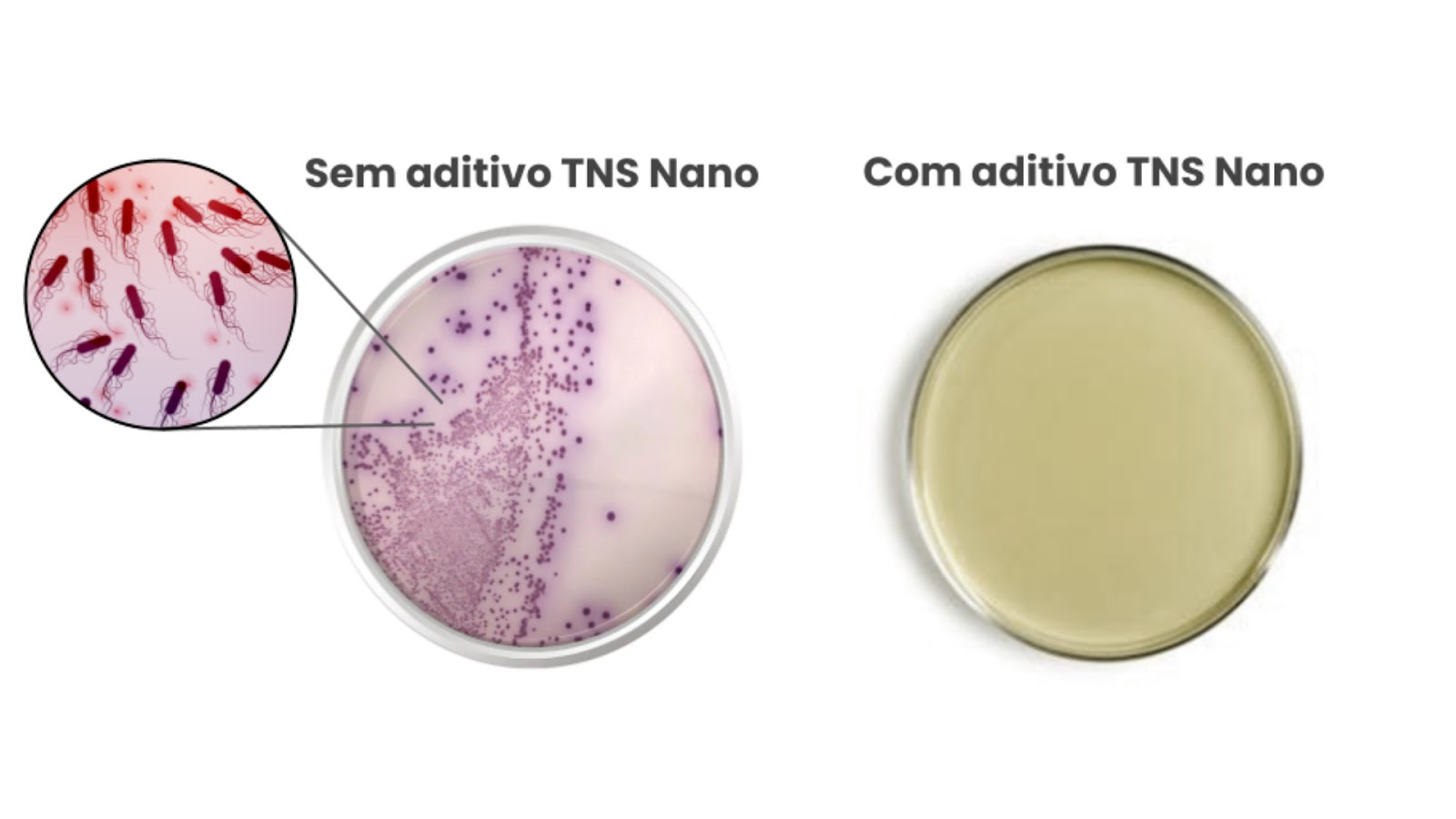
What you cannot see with the naked eye actually exists when viewed through a microscope.
So, now that you know you can trust the effectiveness of this “invisible” antimicrobial that brings very “visible” safety and well-being to a wide variety of environments, please contact us to learn more about TNS Nano.
Read more: Guide to antimicrobials – what you need to know
Where can TNS Nano's nanotechnology be used?
Antimicrobial fabrics
By incorporating antimicrobial additives into the yarn and filament manufacturing process, it is possible to create textile products with permanent antiviral protection.
These antiviral fibers are woven into fabrics and knits that protect the user and can be used safely and effectively in a wide variety of applications.
On public transportation, for example, there is a huge flow of people, and with public health in mind, bus covers with proven antiviral effectiveness have been developed.
Pillowcases that help fight acne
Pillowcases may have the ability to eliminate acne-causing bacteria, and the active ingredient is simple: skin contact with the fabric.
This nanotechnology-based innovation was launched in response to the high prevalence of acne among Brazilians and the demand for simpler solutions to this problem.
Clothing with UV protection
With sun protection factors (SPF) of 50 or higher, these fabrics protect the skin from UVA and UVB rays.
This protection shields against the harmful effects of such exposure, such as sunburn, sunspots, and even skin cancer.
Odor control
Sweat itself is odorless; the unpleasant smell comes from bacteria that thrive in warm, moist environments, such as the armpits and feet.
So, imagine a T-shirt made from smart fabric that inhibits the growth of these bacteria—can you guess what the result would be? If there are no bacteria, there’s no bad odor!
Another major advantage: if your clothes are free of viruses and bacteria and don’t smell bad, you can wash them less frequently, saving both water and energy.
Extending the shelf life of food
When used in polymers, antimicrobials can extend the shelf life of packaged products.
This is because, in the absence of favorable conditions for microorganisms, they do not grow and therefore do not spoil the products.
Antimicrobial flooring and laminates
In flooring and laminates, for example, nanotechnology-based antimicrobial agents help create safer environments, free from the proliferation of disease-causing microbes, while also making cleaning routines easier.
Antifungal grouts and ceramic materials
Nanotechnology can be a valuable ally when it comes to mold and mildew, as incorporating antifungal agents into ceramics and grout provides significantly greater protection and improves well-being.
Read more at: 5 benefits of adding antimicrobial additives to your product
Are you looking for antimicrobial additives for your industry?
TNS Nano is a company that develops antimicrobial additives for various industries.
Using nanotechnology, we have reduced the particle sizes not only of silver but also of other molecules with antimicrobial properties, so that they can be applied to various surfaces.
We care deeply about the environment, which is why all our formulations are based on the principles of green chemistry.
We serve a wide range of industries, including polymers, ceramics, laminates, textiles, footwear, paints, filters and filter elements, and many others.
Apply TNS nanotechnology to your products
We are a global leader in nanotechnology and innovation. Discover how our additives can raise the bar for your operations and ensure high-performance results for your products.
Contact us to learn more about how TNS Nano can make a difference for you!
![[TNS Nano] Sustainability Report](https://tnsnano.com/wp-content/uploads/2023/05/Relatorio-anual-de-sustentabilidade-1.jpg)